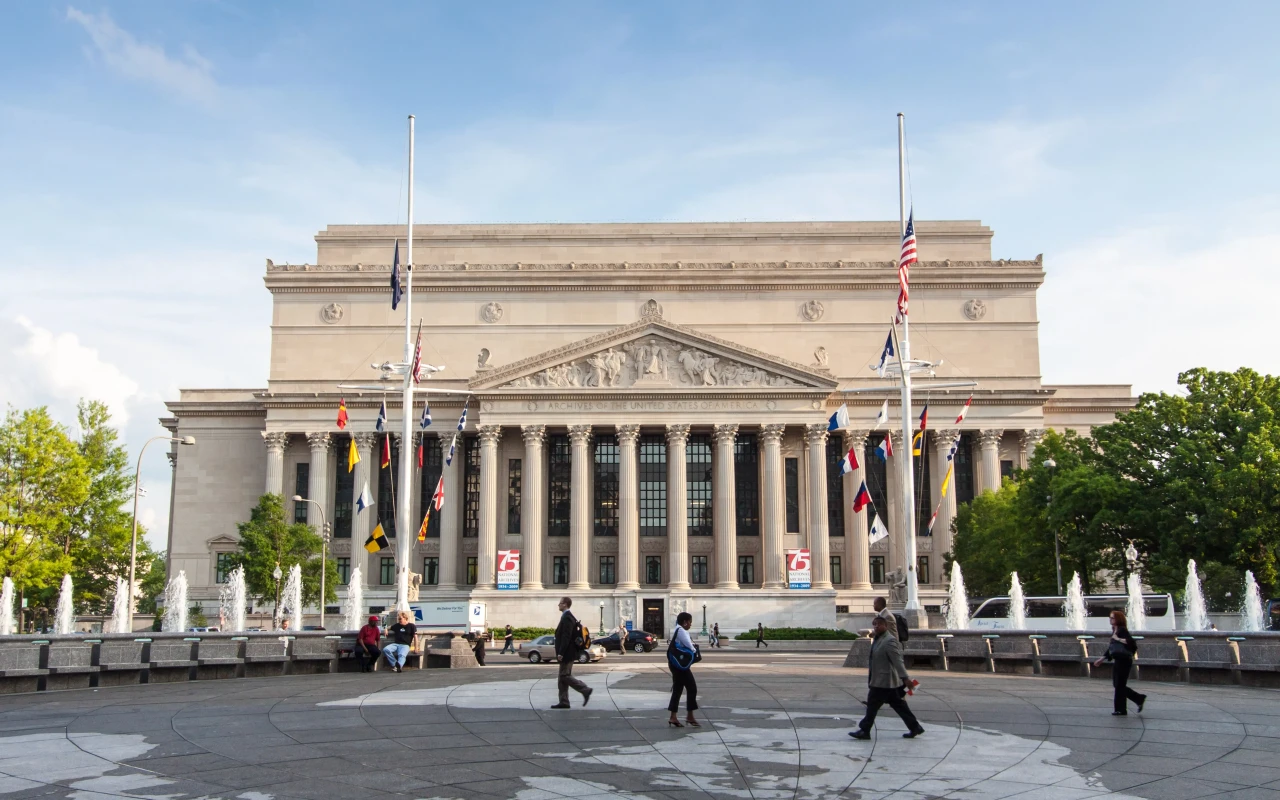
Claim to Fame
The National Archives Museum houses the original Declaration of Independence, Constitution, and Bill of Rights—America’s “Charters of Freedom”—in a striking neoclassical building overlooking the National Mall.
📌 Navigating National Archives Museum : Answers to Frequently Asked Questions
- Admission Fee: Admission to the National Archives Museum is free, although special exhibits may have a fee.
- How Long to Visit: Visitors typically spend about 1.5 to 2 hours exploring the museum.
- Washrooms: Washrooms are available throughout the museum for visitor convenience.
- Hours of Operation: The museum operates from 10 AM to 5:30 PM daily, with extended hours during peak seasons.
- Important Information: It is advisable to check the museum's website for any special events or temporary exhibit closures before visiting.
- Handicap Accessible: The museum is fully handicap accessible, including ramps and elevators.
- Pets: Pets are not allowed inside the museum, except for service animals.
- Guided Tours: Guided tours are available and can be booked in advance or on-site, providing deeper insights into the exhibits.
- Restaurant or Cafe: There is a café on-site offering snacks and beverages, as well as a dining area.
- Gift Shop: A gift shop is located on-site, featuring books, souvenirs, and educational materials.
- Parking: Parking is available at nearby facilities, with some street parking options as well.
- Family Friendly: The National Archives Museum is family friendly, offering interactive exhibits and educational programs for children.
- Photography: Photography is permitted in most areas, but flash and tripods are not allowed.
- WIFI: Free Wi-Fi is available throughout the museum for visitors.
- Picnic Area: There is no designated picnic area within the museum, but nearby parks offer suitable spots.
Photos of National Archives Museum
Located at 701 Constitution Avenue NW, the National Archives Museum invites visitors to stand before the fragile, centuries-old documents that laid the foundation of U.S. democracy. Beyond the Rotunda’s vaulted ceiling, interactive galleries explore the lives of ordinary Americans through immigration passenger lists, Native treaties, and civil-rights records. Whether you’re tracing your family’s immigration journey, viewing the Emancipation Proclamation display, or touring the specially climate-controlled Rotunda, the Archives offers a profound connection to the events and people who shaped the nation.
What to Expect
Enter through the monumental front steps into the Adam‐style marble Rotunda, where the original Declaration of Independence, Constitution, and Bill of Rights are displayed behind bullet-proof glass. After absorbing the Charters of Freedom, proceed to the “Remembering Vietnam” and “Records of Rights” galleries to interact with digitized historical records. In the Public Vaults you can examine digitized ship manifests and the Emancipation Proclamation in high resolution. Special temporary exhibits rotate in the Lawrence F. O’Brien Gallery, showcasing themed document collections such as women’s suffrage or space exploration.
Background and Cultural Context
Established by Congress in 1934 to centralize and preserve federal records, the National Archives opened its museum in this purpose-built neoclassical edifice in 1935. Designed by John Russell Pope, the building’s corridors and reading rooms have hosted presidents, scholars, and citizens seeking to understand America’s documentary heritage. As steward of over 14 billion records, the Archives balances preservation challenges with public access, ensuring that the original records remain stable for future generations.
Best Time to Visit
Weekday mornings (9–11 AM) offer the longest uninterrupted view of the Rotunda before mid-day crowds arrive. Fridays after 2 PM can be quieter, as many researchers depart for the weekend. Avoid Monday afternoons when temporary exhibits may see school-group visits. Plan at least 90 minutes to tour the Rotunda, permanent galleries, and Public Vaults; add time for special exhibitions and the gift shop.
How to Get There
The National Archives Museum is at 701 Constitution Avenue NW. Metro: Yellow/Green Lines to Archives-Navy Memorial-Penn Quarter Station (Exit 1), or Red Line to Judiciary Square with a 7-minute walk. Multiple Metrobus routes and the DC Circulator on Independence Ave serve the Archives. Limited pay-by-space street parking exists on surrounding avenues; public transit is recommended. The building, galleries, and reading rooms are fully wheelchair-accessible; assistive listening devices and American-English captioning are available.
Photo Opportunities
- Wide shot of the Rotunda’s vaulted ceiling and the three Charters of Freedom displays
- Close-up detail of the Constitution’s preamble script preserved under glass
- Interactive “Public Vaults” touch-screen with a holographic view of a ship manifest
- Facade of the marble building framed by cherry trees in spring
- Visitors gazing at the Emancipation Proclamation in the “Records of Rights” gallery
Travel Tips
- No tickets or advance reservations are required—entry to the museum and Rotunda is free.
- Carry a government-issued photo ID for entry; large bags are subject to inspection or may be checked.
- Check the Archives’ website for temporary-exhibit hours and docent-led programming schedules.
- Download the National Archives Catalog app for audio tours and in-depth document background.
- Combine your visit with the nearby National Mall memorials and museums—the Archives sits between the National Gallery and the National Museum of American History.
FAQs
Can I photograph the documents?
Yes—non-flash photography is allowed in most public galleries, including the Rotunda; tripods and flash are prohibited.
Is the Rotunda always open?
Yes—subject to federal holidays and special-event closures; check hours on the official Archives website.
Are guided tours available?
Yes—self-guided audio tours are free via smartphone app; group tours can be arranged by contacting the education office in advance.
Final Thoughts
The National Archives Museum offers an unparalleled encounter with the original documents that define American ideals of liberty and justice. Whether you come to witness the Charters of Freedom, explore multimedia exhibits, or delve into the Public Vaults, a visit here connects you directly with the nation’s story and the enduring power of the written word.