Claim to Fame
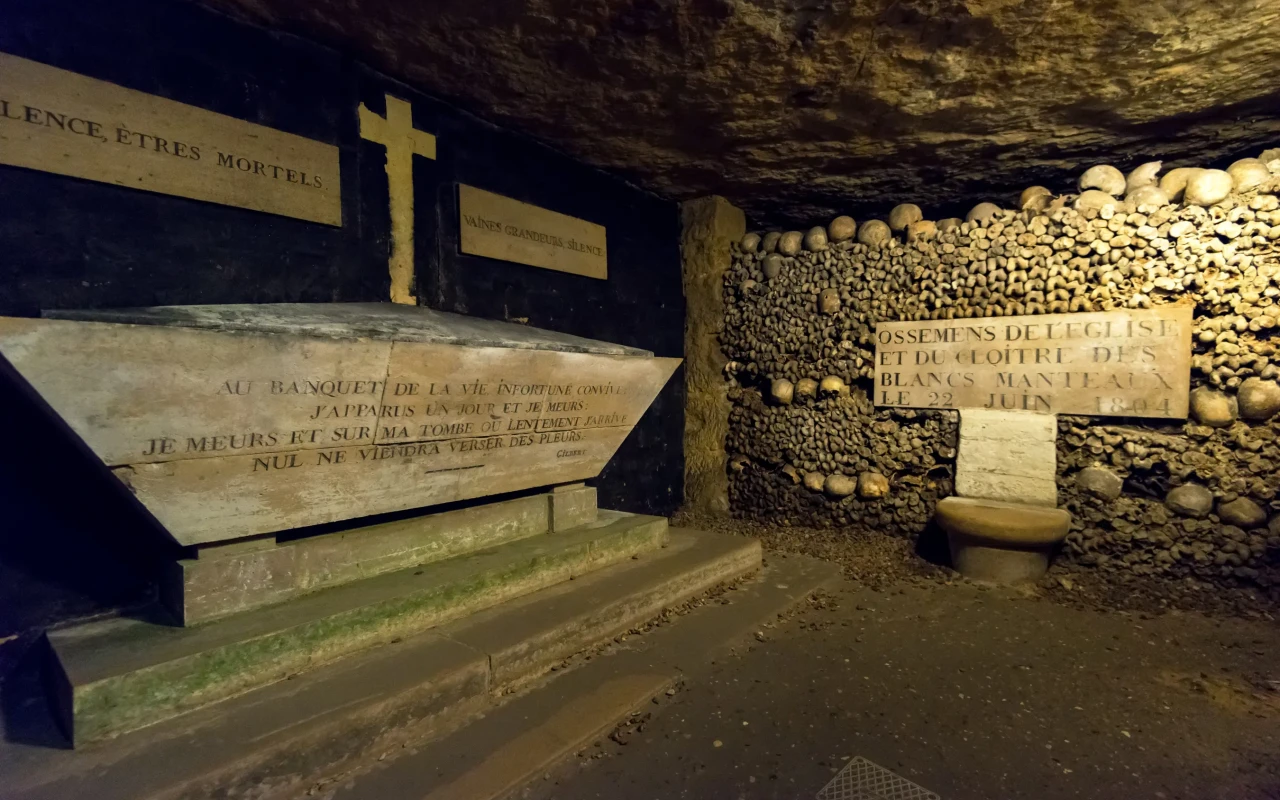
The Paris Catacombs house the bones of over six million people, arranged in hauntingly beautiful formations beneath the streets of the French capital — making it one of the most chilling and visually compelling photo subjects in Europe.
📌 Navigating Paris Catacombs : Answers to Frequently Asked Questions
- Washrooms: Washrooms are available on-site before entering the Catacombs, but there are none within the tunnels.
- Hours of Operation: The Catacombs are open daily from 10 AM to 8:30 PM, with last entry at 7:30 PM.
- Important Information: It is advisable to book tickets in advance to avoid long wait times, especially during peak tourist seasons.
- Admission Fee: The admission fee is approximately €14 for adults, with discounts for students and children.
- How Long to Visit: Visitors typically spend about 45 minutes to 1 hour exploring the Catacombs.
- Admission Fee: The admission fee is approximately €14 for adults, with discounts for students and children.
- How Long to Visit: Visitors typically spend about 45 minutes to 1 hour exploring the Catacombs.
- Washrooms: Washrooms are available on-site before entering the Catacombs, but there are none within the tunnels.
- Hours of Operation: The Catacombs are open daily from 10 AM to 8:30 PM, with last entry at 7:30 PM.
- Important Information: It is advisable to book tickets in advance to avoid long wait times, especially during peak tourist seasons.
- Picnic Area: Picnic areas are not available within the Catacombs; visitors are encouraged to enjoy meals in nearby parks.
- Handicap Accessible: The Catacombs are not fully handicap accessible due to steep staircases and narrow passageways.
- Pets: Pets are not allowed inside the Catacombs to ensure the safety and comfort of all visitors.
- Guided Tours: Guided tours are available, providing in-depth historical context and enhancing the visitor experience.
- Restaurant or Cafe: There is no restaurant or cafe on-site, but visitors can find dining options nearby before or after their tour.
- Gift Shop: A gift shop is located at the entrance, offering souvenirs, books, and memorabilia related to the Catacombs.
- Parking: There is limited parking available near the Paris Catacombs, with street parking and nearby public garages offering options.
- Family Friendly: While the Catacombs can be intriguing for families, the dark and confined spaces may not be suitable for very young children.
- Photography: Photography is allowed in the Catacombs, but flash and tripods are prohibited to preserve the historic site.
- WIFI: Free WiFi is not available at the Catacombs; visitors should prepare to be offline during their visit.
- Restaurant or Cafe: There is no restaurant or cafe on-site, but visitors can find dining options nearby before or after their tour.
- Gift Shop: A gift shop is located at the entrance, offering souvenirs, books, and memorabilia related to the Catacombs.
- Parking: There is limited parking available near the Paris Catacombs, with street parking and nearby public garages offering options.
- Family Friendly: While the Catacombs can be intriguing for families, the dark and confined spaces may not be suitable for very young children.
- Photography: Photography is allowed in the Catacombs, but flash and tripods are prohibited to preserve the historic site.
- WIFI: Free WiFi is not available at the Catacombs; visitors should prepare to be offline during their visit.
- Picnic Area: Picnic areas are not available within the Catacombs; visitors are encouraged to enjoy meals in nearby parks.
- Handicap Accessible: The Catacombs are not fully handicap accessible due to steep staircases and narrow passageways.
- Pets: Pets are not allowed inside the Catacombs to ensure the safety and comfort of all visitors.
- Guided Tours: Guided tours are available, providing in-depth historical context and enhancing the visitor experience.
Photos of Paris Catacombs
Why the Paris Catacombs Are a Unique Photography Experience
Unlike any other photographic subject in Paris, the Catacombs invite a study of mortality, history, symmetry, and shadow. This underworld of ossuaries — silent, solemn, and arranged with artistic intention — offers striking compositional challenges. Whether you’re capturing the repetitive lines of skulls and femurs or the eerie ambiance of candle-lit corridors, the Catacombs reward a slow, thoughtful approach.
Best Time to Visit and Shoot the Catacombs
- Weekday mornings: Book the first time slot of the day to avoid crowds and enjoy longer setup time for your shots
- Low tourist seasons: January through March or late October to November see fewer visitors
- Timed tickets only: Entry is by online reservation, so plan your shoot accordingly
Note: The entire public route is roughly 1.5 km and takes about 45 minutes to walk, though stopping for shots may take longer.
Location and Access Info
- Entrance: 1 Avenue du Colonel Henri Rol-Tanguy, 75014 Paris, France
- GPS Coordinates:
48.8338, 2.3324 - Nearest Metro: Denfert-Rochereau (Lines 4 & 6, RER B)
Top Photography Spots Within the Catacombs
- "Stop! This is the empire of the dead": The famous entry sign to the ossuary — shoot this head-on with a wide aperture to separate it from the background
- Wall of Skulls: Repeating patterns and textures make for abstract or symmetrical shots — shoot from a low angle for depth
- Bone Crosses and Altars: These arranged monuments offer emotional weight — ideal for moody compositions
- Curved Passageways: The slight curves of the tunnels are ideal for leading lines and depth-of-field studies
Recommended Gear for the Catacombs
- Compact wide-angle lens (e.g., 16–35mm): Space is tight; go wide for environmental shots
- Fast prime lens (e.g., 35mm f/1.4 or 50mm f/1.8): Great for low-light handheld shots with shallow depth
- Monopod or mini tripod: Full tripods are not permitted — a small support system can help for stability
- Mirrorless or low-light DSLR body: Choose a camera with strong high ISO performance (ISO 3200–6400 range)
- Extra batteries: Long exposures and LCD previews will drain power quickly underground
Lighting and Exposure Tips
- Use natural lighting: Flash is not permitted, and artificial lighting is discouraged — embrace shadows and adjust ISO
- Manual white balance: Set for tungsten/incandescent or custom to avoid yellow casts from underground bulbs
- Long exposures: Shoot at 1/5s or slower using body stabilization or a mini tripod on ledges
- Expose for highlights: Avoid blowing out the limited overhead lighting — it's easier to recover shadows
Photographic Style Considerations
- Black and white processing: The Catacombs are ideal for monochrome — deep blacks and strong textures
- Symmetry and abstraction: Look for repeating patterns of bones and curved tunnels for graphic compositions
- Emotion and atmosphere: Use negative space and soft focus to emphasize the eerie quiet of the space
- Human scale: When possible, include silhouettes or partial figures to convey scale and emotion
Rules and Restrictions to Consider
- No flash or external lighting: Strictly prohibited to preserve the ambiance and structure
- No tripods (officially): Some handheld stabilizers or mini tripods may be tolerated, but avoid obstruction
- Respect required: This is a burial site — be discreet, respectful, and quiet at all times
- No commercial shoots without a permit: If you're working on an editorial or publication, apply in advance
Post-Processing for the Catacombs
- Crush blacks: Deepen shadows for mood while preserving bone texture
- Add film grain or vignette: Helps evoke a timeless, documentary feel
- Selective clarity: Enhance the texture of bone walls without making the image overly sharp
- Desaturate yellows: The warm light underground often needs slight color correction
Final Thoughts: Capturing the Weight of History
Photographing the Paris Catacombs is unlike any outdoor or architectural shoot — it’s a quiet, reverent exploration of history, mortality, and artistry. You won’t come home with bright colors or sweeping vistas, but you’ll have something far more rare: images that feel like whispered secrets from beneath the surface of one of the world’s most photographed cities.